Canada: Ru and Unearthing
Diplomatica’s ‘Great Reads from Around the World’ #1
Full details about my Diplomatica ‘Great Reads from Around the World’ project are here.
Hello! Welcome to my first, hopefully monthly, installment of my Great Reads from Around the World project AND my Top 100 Canadian Books of All Time project. My goal here is to try to figure out what each book from the ‘Great Reads’ list is saying about its country, and to decide whether or not I agree with my statistical rankings of the Top 100 Canadian Books.
Top 100 Canadian Books
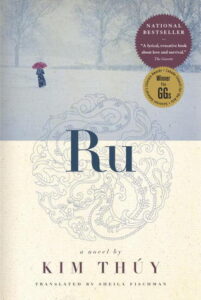
Let’s start with Ru, by Kim Thuy, which is #20 on my Top 100 Canadian Books of All Time list. “Ru” means “lullaby” in Vietnamese and “river” in French, and this novel flows along a young girl’s journey from Vietnam to a Malaysian refugee camp and finally to Quebec, through to her adulthood as a mother of a child with autism.
Do I agree or disagree with its placement in the top 20? Honestly, it’s kind of hard for me to say at this point, not having made much of a dent in the list yet. I do think it’s well-written and addresses important issues, like the struggles immigrants go through to find their place in a new society. To me, though, it was a little too fragmented. Most chapters were half a page long, and it would jump between times and places with each chapter. There were times when I wished Thuy would give us more, let us stay in a moment longer. I gave it 4 stars for the beauty of the writing, but I don’t think it will become an enduring favourite of Canadian literature for me.
Great Reads from Around the World: Canada
Both Ru and Unearthing, by Kyo Maclear, were suggested by the Canadian embassy in Washington, D.C., as books that encapsulate the literary traditions and cultural heritage of Canada. While reading Ru, which is about a Vietnamese refugee (a “boat person”) to Quebec struggling with her identity and being a mother of a boy with autism, I had a hard time putting my finger on why it was chosen. There really isn’t much about Canada in this book. The characters even refer to their “American dream,” which I suppose refers to “North America,” but it was still jarring to see the term in a Canadian book.
However, partway through reading Unearthing, it started to make more sense.
Unearthing: A Story of Tangled Love and Family Secrets
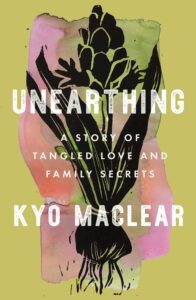
Unearthing is a memoir about the author’s discovery through a DNA test that the father who raised her is not her biological father. After being raised to believe she’s half Japanese and half British, she discovers that she’s half Japanese and half Jewish. This sends her on a quest, not only to discover who her biological father is, but to figure out who she is, and who her parents really were underneath all their secrets and lies.
Unearthing is similar to Ru in a lot of ways. Both books are about Canadian immigrants of Asian descent grappling with issues of identity and memory. Both are based on the author’s own experiences, though Kim Thuy novelizes hers. In both, the main character is a first-generation Canadian mother of two Canadian sons. And both books are written in a fragmented way, with the narrative bouncing back and forth through time. But comparing the two in the context of “books that encapsulate Canada,” I felt like I was missing something. Until I got to this passage on page 169 of Unearthing:
“Still, the white neighbors who regarded the plants in my mother’s garden as ‘foreign,’ or even ‘non-native,’ were setting a vibe and it was less one of decolonial solidarity than cordon sanitaire. Which is to say the line between an ‘exotic,’ ‘imported’ and ‘invasive’ species is sometimes a matter of basic horticulture and sometimes a matter of simple xenophobia.
“What is vibrant and desirable and what must be brought under control? Who decides?
“As Robin Wall Kimmerer, the great Potawatomi elder and scientist, reminds us, there are ‘non-native’ plants that have lived peacefully in the Americas, without infesting or invading habitats. Moss, flowers, dandelions, sorrel, plantain, clovers have existed without issue amongst Indigenous plant worlds. The questions Kimmerer poses of any settler are reminders that conquest is not the only route to survival: How can you be a naturalized, beneficial plant? How can you respect local ways? Who and what is here? What will be your terms of relation?”
What these books say about Canada
I think that these books were chosen because they tell a story that every non-Indigenous Canadian should be able to relate to. At some point, either we or our ancestors came to this country. Maybe we/they were welcomed here, maybe we/they weren’t. But even though we’ve planted ourselves here, we still hold a piece of ancestral memory within us. There’s still some part of us that’s connected to where our original seeds came from. And yet we’re all trying to bloom and grow together now. Sometimes it works, and sometimes it doesn’t. There are those among us who want to choke the growth of our neighbours and restrict their access to the North American dream. But for the most part, we’re at least trying to be “beneficial plants” and grow in harmony with those around us.
I recently read Rick Mercer’s second memoir, The Road Years, in which he (spoiler alert) comes to the conclusion that what unites and defines Canadians is our quest to make the world around us a better place. I think that message comes through in these two books. Even though the main character in each book is on a quest to discover or reclaim her own identity, she and her parents choose to be Canadians to give the next generation the best chance at a good life. And each book ends on a hopeful note, demonstrating the inherent optimism in the Canadian outlook.
As for our “literary traditions,” well… Canadian literature has always been hard to define. And I think there’s one simple reason for that: our literature is as much of a mosaic as our diverse population is. Canadian literature doesn’t fit neatly into a box. We don’t have strictly-enforced rules of structure or content here. Each of these authors has her own unique writing style, and that feels pretty darn Canadian to me.
Both Ru and Unearthing are available on Bookshop.org*
*As an affiliate, I’ll get a small commission from any purchase made through this link.