Ancient Egyptian: The Egyptian Book of the Dead
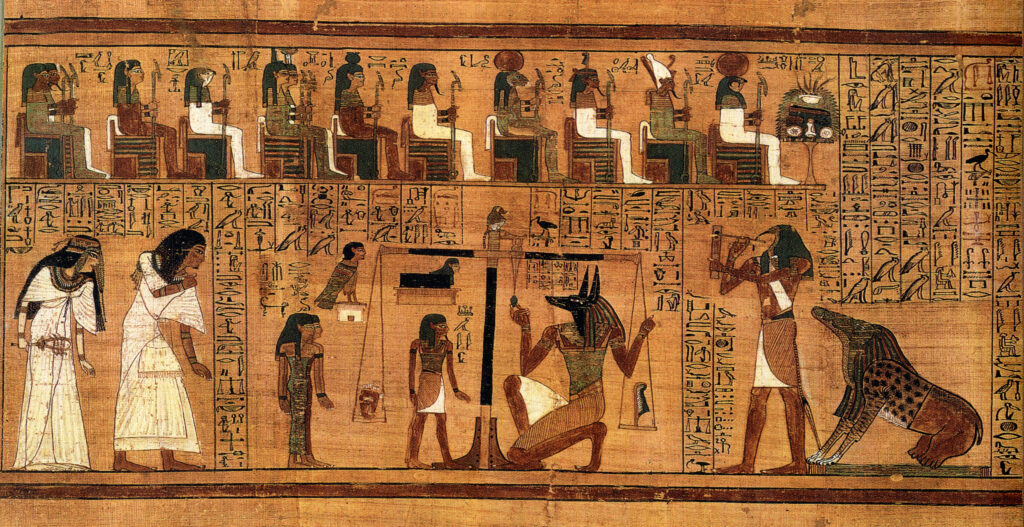
The Book of the Dead
I talked briefly about Ancient Egypt’s The Book of the Dead in my post about Ancient Egyptian language and literature a couple months back, but today I’ll take a more in-depth look at this most famous work of Ancient Egyptian literature. The Book of the Dead is a collection of ‘spells’ or prayers that was left in a deceased person’s coffin or burial chamber to help them on their journey into the afterlife. It appeared to go through many changes over the centuries of its popular use. Each collection was probably tailored to the needs of each deceased person, since no two contain the same arrangement of spells.
The most complete version of The Book of the Dead that survives today is The Papyrus of Ani, which is the version I read and will be talking about here. Ani was a scribe who died around 1250 BC/BCE. The edition I read (details below) offers a detailed description of the papyrus, including its measurements and the composition of the material (p. clii). (If you’re interested to see the full papyrus, Wikipedia has a scrollable image here.)
However, the information that seized my attention the most was that not all of the sections were specifically written for Ani. There is evidence that “his name has been added in several places by a later hand” (p. cliii), which indicates that some Book of the Dead segments were sold pre-written with blanks where the deceased’s name should go. Yet again, reading these ancient classics teaches us that some things about human society never really change!
The format of the papyrus
The Papyrus of Ani “contains a number of chapters of the Book of the Dead, nearly all of which are accompanied by vignettes” (p. clii). The illustrations (vignettes) were clearly added first, since at times the text had to be squeezed in beside them (p. cliii). In the edition I read, a section is devoted to the original hieroglyphic text with a word-for-word translation underneath. This makes it easy to study what each symbol means and how the Ancient Egyptian language was structured. It also notes line breaks and numbers each line for easier reference. The final section of the book offers a full English translation and also describes each vignette in great detail. I highly recommend this edition if you’re looking for one to read or collect (purchase link below).
How the ‘spells’ were used
The prayers, litanies, and spells contained within The Book of the Dead were used as recitations or chants by priests and/or the bereaved. It was believed that these acts “would secure for the dead an unhindered passage to God in the next world, would enable him to overcome the opposition of all ghostly foes, would endow his body in the tomb with power to resist corruption, and would ensure him a new life in a glorified body in heaven” (p. xxi). This belief stems from the story of Osiris and Isis, two major gods in the Egyptian pantheon.
The story of Osiris
While the story of Osiris has not been found in its entirety, bits and pieces of it appear so prolifically throughout all of Ancient Egyptian literature that it’s clear it was a well-known story that didn’t require a full explanation at the time. Briefly, Osiris was a god-king who was murdered, cut into pieces, and the pieces scattered far and wide. Isis, wife of Osiris, went in search of the pieces, and each time she found one, she built a tomb. Once she had found all the pieces, Isis succeeded in bringing Osiris back to life (pp. lix-lxi).
Like Osiris, the Ancient Egyptians believed their bodies would rise again if the right rituals were undertaken.
The ka
The life force or spiritual aspect of a person, the “individuality or personality endowed with all his characteristic attributes” (p. lxxi), was called the ka. It was the ka that Ancient Egyptians believed lived on and had tangible needs in the afterlife. Many of The Book of the Dead‘s spells were on behalf of the ka, asking the gods to provide for it on its journey. And it was for the ka that tombs were lavishly decorated and filled with offerings of food and drinks. “When circumstances rendered it impossible to continue the material supply of food, the ka fed upon the offerings painted on the walls of the tomb, which were transformed into suitable nourishment by means of the prayers of the living” (p. lxxiii).
Example of a Book of the Dead hymn
From page 323:
Vignette: Ani, standing with both hands raised in adoration. Behind him is his wife: Osiris, the lady of the house, priestess of Amen, Thuthu.
Text [Chapter XV.]: (1) A hymn of praise: “O Osiris, lord of eternity, Un-nefer, Horus of the two horizons, whose forms are manifold, whose creations are without number, (2) Ptah-Seker-Tem in Annu, the lord of the tomb, and the creator of Memphis and of the gods, the guide of the underworld, whom [the gods] (3) glorify when thou settest in Nut. Isis embraceth thee in peace, and she driveth away the fiends from the mouth of (4) thy paths. Thou turnest thy face upon Amenta, thou makest the world to shine as with smu metal. The dead rise up to behold thee, they breathe the (5) air and they look upon thy face when the disk shineth on its horizon; their hearts are at peace for that they behold thee, O thou who art eternity and everlastingness.”
Citing my sources
I hope you enjoyed my look at The Egyptian Book of the Dead! I’m so excited to finally own my own copy. If you would like to get your hands on the same edition I used, you can find it here on Bookshop.org.* There’s also a revised edition available, but this is the info for the one I have:
Budge, E.A. Wallis (translator). The Egyptian Book of the Dead: The Complete Papyrus of Ani. Clydesdale Press, 2021.
*As an affiliate, I will get a small commission from any purchase made through this link. I appreciate your support!