Reading Steinbeck in Two Years #2: The Pastures of Heaven
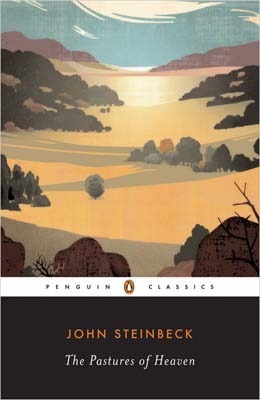
Goodreads blurb
Each of these delightful interconnected tales is devoted to a family living in a fertile valley on the outskirts of Monterey, California, and the effects that one particular family has on them all. Steinbeck tackles two important literary traditions here; American naturalism, with its focus on the conflict between natural instincts and the demand to conform to society’s norms, and the short story cycle. Set in the heart of ‘Steinbeck land’, the lush Californian valleys.
My thoughts
I’ve been putting off writing this review for a couple of months now, and for a kind of embarrassing reason. You see, I wanted to bring a certain amount of intellectual gravitas to my Reading Steinbeck in Two Years project (I earned a BA in English not too long ago, so I do know I’m capable of gravitas). But my first thought when I started reading The Pastures of Heaven was, “Hey, this is like the Fear Street series! Cool!” and I haven’t yet come up with a better way to approach this review. But you know what? This is MY Steinbeck reading project, and if I want to compare one of his works to a cheesy YA horror series from the 1990s, I darn well will! So, here we go.
Wait for it
The Pastures of Heaven begins “some time about 1776” with a cruel corporal discovering a peaceful valley (I say “discovering” in the way that European settlers “discovered” anything in the Americas – by following in the footsteps of Indigenous people and deciding they don’t count) and declaring it “the green pastures of Heaven to which our Lord leadeth us” (p. 2). Steinbeck’s writing in this chapter drips with sarcasm, so I have to share a couple of quotes here:
[on the Indians who escaped from the Christian Mission and were tracked down by the military] It was a week before the soldiery found them, but they were discovered at last practising abominations in the bottom of a ferny canyon in which a stream flowed; that is, the twenty heretics were fast asleep in attitudes of abandon. (p.1)
[on the cruel corporal] The disciplinarian corporal felt weak in the face of so serene a beauty. He who had whipped brown backs to tatters, he whose rapacious manhood was building a new race for California, this bearded, savage bearer of civilization slipped from his saddle and took off his steel hat. (p.2) (I particularly love the “savage bearer of civilization” part. What any writer would give to come up with wording like that! And this was only the man’s second published work!!)
The Spanish corporal, the discoverer, always intended to go back. Like most violent men, he looked forward with sentimental wistfulness to a little time of peace before he died. (p. 2)
An Indian woman presented him with the pox, and, when his face began to fall away, good friends locked him in an old barn to prevent the infection of others. (p. 2)
A fitting end to him and his “rapacious manhood,” I must say. I also had a giggle over the bluntness of, “His descendents [sic] are almost white now.” (p. 2) Maybe there’s a slight racist undertone there, I don’t know. But for a European settler who had obviously been raping Indigenous women all over the New World, it felt like fair derision to me. Anyway. That’s the gist of the opening chapter.
Here’s the Fear Street part
The second chapter begins with this: “To the people of the Pastures of Heaven the Battle farm was cursed, and to their children it was haunted.” (p. 4) So I’m sure you can forgive me for thinking, “OMG! The town was built in the valley where the escaping Indians had taken refuge from the cruel corporal guy, and it was cursed when he dragged them away from it! This is like the Fear Street series!”
Yes, I was really that excited.
And to a certain extent, I think that might have been Steinbeck’s initial intention. The first few short stories in this collection certainly do have a spooky edge to them, with strange things happening to the people of this town. Chapter 2 ends on this ominous note:
Bret had been frowning soberly as a new thought began to work in his mind. ‘I’ve had a lot of bad luck,’ he said. ‘I’ve been in a lot of businesses and every one turned out bad. When I came down here, I had a kind of an idea that I was under a curse.’ Suddenly he laughed delightedly at the thought that had come to him. ‘And what do I do? First thing out of the box, I buy a place that’s supposed to be under a curse. Well, I just happened to think, maybe my curse and the farm’s curse got to fighting and killed each other off. I’m dead certain they’ve gone, anyway.’
The men laughed with him. T.B. Allen whacked his hand down on the counter. ‘That’s a good one,’ he cried. ‘But here’s a better one. Maybe your curse and the farm’s curse has mated and gone into a gopher hole like a pair of rattlesnakes. Maybe there’ll be a lot of baby curses crawling around the Pastures the first thing we know.’ (p. 16-17)
For the first few stories, that seemed to be where Steinbeck was going with this collection. After a while, though, they were just sort of… stories. Which is fine, but I kept expecting supernatural twists that never came, and I felt a bit disappointed. I’ve come to understand that Steinbeck just hadn’t mastered cohesion in his writing yet by this point in his career. Still, there are some gems in this collection. Some great Steinbeckian insights into human nature, too.
I’ll end on another quote I liked
‘After the bare requisites to living and reproducing, man wants most to leave some record of himself, a proof, perhaps, that he has really existed. He leaves his proof on wood, on stone or on the lives of other people. This deep desire exists in everyone, from the boy who scribbles on a wall to the Buddha who etches his image in the race mind. Life is so unreal. I think that we seriously doubt that we exist and go about trying to prove that we do.’ (p. 46)
Well, John Steinbeck, I don’t think that anyone can deny that you existed. I’m glad you left such beautiful scribbles behind to prove it.
The Pastures of Heaven is available to purchase on Bookshop.org (in US and UK) and on Booksellers.ca (in Canada). Please note: These are affiliate links, and I might earn a small commission from any purchase made through them, at no extra expense to you. Bookshop.org and Booksellers.ca support independent bookstores while offering the convenience of shopping online.
Leave a Reply