Son of Nobody by Yann Martel: REVIEW
Goodreads Blurb
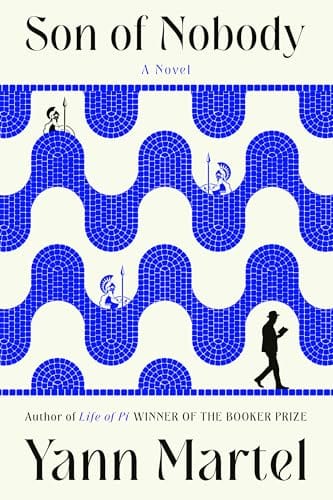
From the author of the international bestseller Life of Pi, a brilliant retelling of the Trojan War from two commoners: an ancient soldier and a modern scholar.
Homer’s Iliad and Odyssey were not the only ancient tales of the Trojan War. In Son of Nobody, Yann Martel composes a new the Psoad, an epic in free verse that follows a goatherd’s son, Psoas of Midea, who leaves his wife and family to fight at Troy. Psoas meets his doom and the poem of his life is lost—until a Canadian academic studying at Oxford, Harlow Donne, discovers its relics thirty centuries later. As Harlow assembles and comments on the fragments in footnotes, he retrieves memories of his wife and daughter and grapples with questions of ambition, family, and responsibility in both the ancient and modern worlds. Son of Nobody upends the regal perspective of traditional epics and shows that “the past is never done with, that always there are parallels and returns and repetitions, always the song continues.”
My Review
The Iliad by Homer is one of my favourite books of all time. So is Life of Pi by Yann Martel, the author of Son of Nobody. And I’m always drawn to novels that experiment with form and stretch the boundaries of what a novel can be. So while this book won’t be for everybody, it was practically tailor-made for me.
In this book, Martel essentially writes a new perspective of the Trojan War in a similar epic format to the originals. At the same time, he picks it apart line by line through the perspective of fictional Classics scholar Harlow Donne, whose obsession with this new-found epic poem threatens to destroy his life and career. And in the footnotes of Donne’s scholarly work (or is his scholarly work the footnote?), Donne tries to explain to his daughter why he wasn’t there for her in the meantime. The three aspects of the novel blend together beautifully, with Psoas and Donne’s lives beginning to parallel along the way, and Donne’s scholarly asides becoming longer and longer as he uses his work to escape from the shambles of his life.
Where it’s strongest
The strongest passages are those dealing with Donne’s love for his daughter. There are parts of this book that are intensely moving, especially Donne’s responses to a certain repeated line in the Psoad. You can really feel Donne’s grief and regret even on its own, so to pair that with passages of pure Greek drama was a brilliant choice and extremely effective. In a way, it even makes us feel closer to the ancient Greek heroes who went through the same things we still go through today. We can better empathize with their larger-than-life pain once we measure it against our own.
Where it’s weakest
There were only two things that I didn’t really enjoy about this book. One was the way Donne’s arguments with his wife were approached. Without really any explanation or lead-up, they’d suddenly both be completely unreasonable and vicious with each other. Donne seemed much more thoughtful than that at all other times, so I just had trouble reconciling that with his character. Also, I wanted to knock their heads together and tell them both to get over themselves, which took me out of the emotion of the moment. I know people do act like that, but it bugs me.
The other thing was the way Donne would bring Jesus and the biblical Gospels into his discussion of Psoas. I thought it would turn out at the end to be a kind of angry-with-religion thing, as though he felt Jesus had been working against him like several of the Greek gods worked against the Greeks or the Trojans. But it took another direction, and I didn’t quite understand the point he was trying to make or why he was trying to make it. I wish that had been made a little clearer, or else left out entirely.
In conclusion
All in all, though, I really enjoyed this. It’s the kind of book you walk away from thinking, “Wow, I’ve never read a book like that before.” Whether you’re glad you did or wish you hadn’t is up to you, but personally, I’m glad I did.
Many thanks to NetGalley and Penguin Random House Canada for the advance digital copy. All opinions are my own.
Son of Nobody is available to purchase now. If you’d like to support the continued existence of this blog, I will receive a small commission from any purchase made through the affiliate links below, at no extra expense to you. If not, that’s fine, and I highly recommend looking for Son of Nobody wherever you get books.
For US and UK: Bookshop.org
For Canadians: Booksellers.ca